Saturday, July 10, 2010

The Perfect Sandwich Rye Bread

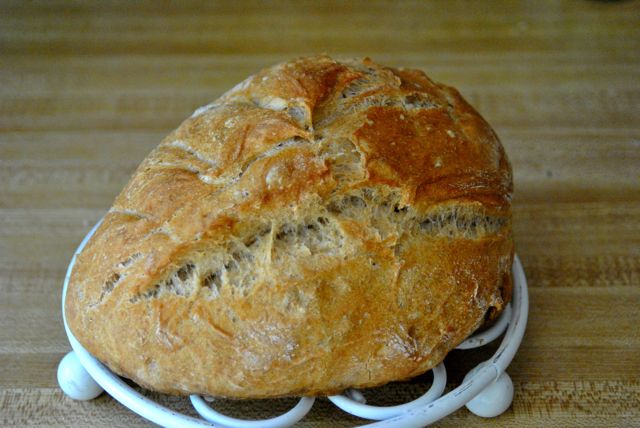
This week I made another recipe adapted from Daniel Leader's Local Breads, and it has taken me through the week with one delicious sandwich after another.  For Bread Nut readers looking for a softer-crusted, lighter rye that's easily sliced and stays fresh for several days and still packs in the nutritional punch, you need to make this rye bread.  This week, this bread has been the foundation for tempeh sandwiches, veggie sandwiches (I used fresh spinach, whole grain mustard, and soy cheese), and good old peanut butter and jelly.

The bread contains flaxseeds and sesame seeds, which Leader recommended soaking overnight. This would probably be a good idea as the soaked seeds contribute to the moisture of the dough; however, I forgot to do this and the bread turn out just fine with the seeds mixed right into the dough.  This bread also bakes at a lower temperature (400 degrees) than most of Bread Nut's other breads, giving it a softer crust than traditional rye bread.

Flax and Sesame Seed Rye Bread
1/4 cup sourdough starter
3/4 cup water
1/4 cup flaxseeds
1/4 cup seseame seeds
2 teaspoons active dry yeas
1 cup bread flour
2/3 cup rye flour
3/4 teaspoon salt
  1. In a medium bowl, mix together the sourdough starter and water.  Set aside.
  2. In a large bowl, mix the dry ingredients together.  Stir in the sourdough starter mixture and mix until the ingredients bind together and are ready to knead.
  3. Knead the dough for ten minutes on a lightly floured surface, flouring your hands as necessary.  Try not to add too much flour to the dough as you are kneading.  Let the dough rest, uncovered, for ten minutes.  Transfer to a lightly oiled bowl, cover with plastic wrap and allow to rise for about two hours, or until doubled in bulk.
  4. After two hours, uncover the dough and shape it into a loaf.  Place in a lightly oiled bowl and let rise again for about one hour.  
  5. One half hour before baking, place the Dutch ovens in the oven and preheat at 400 degrees.
  6. Uncover the Dutch oven and place the dough inside.  Score the dough and sprinkle with sesame seeds.  Replace the lid and bake for 40 minutes.  After 40 minutes, remove the lid and bake for another five minutes or until the internal temperature of the bread reaches 200 degrees.  Remove from the oven and cool completely before slicing. Enjoy!

Monday, July 5, 2010

Tomato Basil Focaccia, Garlic Herb Sourdough, and Sesame Braided Challah--all in one holiday weekend

Along with several other breads made--and quickly consumed by friends--this holiday weekend, I made Bread Nut Bakery's first focaccia.  Focaccia is an Italian flat bread that is usually topped with a combination of olive oil, herbs, cheese, fruits, and vegetables.  The ingredients in focaccia dough are very similar to pizza dough: yeast, flour, salt and a surprising amount of oil.

Focaccia is a fantastic bread for those just starting to make their own breads--or in my case--those who want to make bread quickly, without the daylong proofing times characteristic of sourdough breads.  If you make the focaccia thick enough to slice widthwise, it's a bread for grilled vegetable sandwiches, which is how my focaccia bread was happily consumed on Saturday.  I chose fresh tomatoes and fresh basil (from my garden) along with some minced garlic for my toppings.  Here's the recipe:

Tomato Basil Focaccia
Adapted from Local Breads by Daniel Leader

Makes 6 individual focaccia loaves

Dough:
1 1/4 cups warm water (105-115 degrees)
2 tsp. active dry yeast
1/3 cup extra virgin olive oil
3 1/4 cups bread flour
1 1/2 tsp. sea salt

 Toppings
1 medium roma tomato, thinly sliced
1/4 cup fresh basil, chopped
1 large clove garlic, minced
1/2 cup olive oil
  1. In a small bowl, mix the yeast and the water until the yeast dissolves.  Let sit for ten minutes.  After ten minutes, add the olive oil to the yeast mixture.
  2. In a large bowl, mix the flour and salt.  Add the yeast-oil mixture to the dry ingredients and stir until blended into a dough.
  3. On a lightly floured surface, knead the dough for about 12 minutes, or until smooth and elastic.  Transfer the dough to a lightly greased bowl, cover with plastic wrap, and let rise at room temperature for 1 to 1 1/2 hours, or until the dough doubles in volume.
  4. Uncover the dough and divide it into six equal parts.  Use your fingertips to shape each piece into a round, flat loaf and arrange loaves on two greased baking sheets.  Brush the loaves with olive oil and lightly press the toppings over the top of the dough.  Cover the baking sheets with palstic wrap or a toil and let rise again for 30 minutes. 
  5. Preheat the oven to 375 degrees.  Position one oven rack in the upper third of the oven and one in the middle.  Bake the focaccias until golden brown, about 15-20 minutes.  Switch the baking after 10 minutes of baking so the breads bake evenly.  Enjoy!
Below are two more of this weekend's other breads: Sesame Braided Challah (which made amazing French toast!) and Garlic and Herb Sourdough.

Friday, June 18, 2010

BreadNutBakery.com

Hello crEATe friends!  About a month ago, I announced that crEATe would be undergoing some big changes, and they're finally here.  After much thought about the direction crEATe would take, I've decided to take the blogging into the real world and start a business focusing on bread, an ongoing crEATe theme.  A few changes to note:
  • crEATe is now Bread Nut Bakery.  This means that http://a2create.blogspot.com is now http://www.breadnutbakery.com.  The old web address will redirect, but you'll now be able to find Bread Nut Bakery through an internet search.  
  • The main focus of BreadNutBakery.com will be bread baking and the process of starting a bread business.  But don't worry: you'll still find easy vegan/vegetarian recipes and opinion pieces here, too.
  • This is an experimental process: I'll be sharing recipes with you as well as the steps I'm taking to attempt to get this business up and running.  This means that--more than ever--I'd love our comments, feedback, and suggestions!
It's been my goal for a while to grow a business from crEATe, and I've finally decided to focus on bread.  Baking bread has always been my passion, and working with a sourdough starter has given me the opportunity to really explore how bread works. I started by asking myself these two questions?
  1. Is there a market in Greensboro for artisan breads?
  2. What breads do I make well enough to sell to the public?
To answer the first question, I started exploring the bakery sections of every grocery store I could find in town, visiting local and franchise bakeries, and checking out area Farmer's markets.  I'm still looking around, but after two weeks, I've found a small selection of artisan breads, at upscale markets and one local bakery in particular, which leads me to think that there could potentially be a demand for more fresh, locally-baked artisan breads.  A couple of people have suggested opening a Jewish or Jewish-style bakery, because some breads I bake a traditionally Eastern European or Jewish and I also have--and can make--a plethora of old-world Jewish family recipes for breads and desserts.

Determining the answers to the second question was fun.  I set off to do some research--both on the web and in some classic cookbooks--on how to make my bread better.  Some changes I've made are:
  • Shorter rising times in hot and humid weather (some of my rising times have been reduced from 18 hours to only 8)
  • Slightly more flour (or less water)
  • Less kneading (except for in the case of no-knead breads)
  • Shorter baking times (particularly in the final, uncovered portion of Dutch oven baking)
After a week of bread baking, I've decided on five breads to focus on: Challah, French, Sourdough, Wheat, and Rye.  See below for some photos.

I'd love your comments on any part(s) of ths process as this is an entirely new exploration.  Please comment below or email! Next week's post: finding a place to bake for the public.  Any helpful suggestions are most appreciated!